

BE-FRIENDING SISTER DEATH
Fr Billy Swan
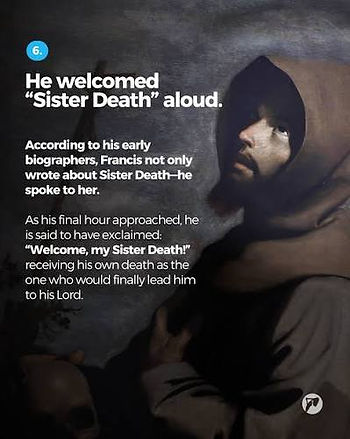
The feast of All Souls this year takes place less than a month after the 800th anniversary of the death of St Francis of Assisi (1181-1226). In this article, I try to unpack how St Francis encourages us not to be afraid of death but to befriend it as an experience that awaits us all and to prepare for it every day.
Towards the end of his life as he fell ill and as his death approached, St Francis wrote his beautiful ‘Canticle of the Creatures’ – a poem that captures his love for God and for all things. It profoundly captures the connection he felt with all creation. Included in the Canticle is a reference to what he called ‘Sister Death’ – a term that indicates an awareness of his passing that was immanent but also an understanding of death that welcomed it as part of life and a mystery that all of us must embrace. After praising God through Brother Sun and Sister Moon, Brother Wind and Sister Water, Brother Fire and Sister Mother Earth, and through peacemaking, Francis turns to face death:
“Praised be You, my Lord, through our Sister Bodily Death, from whom no one living can escape. Woe to those who die in mortal sin. Blessed are those whom death will find in Your most holy will, for the second death shall do them no harm”.
The first thing to note is Francis’ desire that God be glorified by his coming death. He finds joy in praising God as a continuous mantra throughout the Canticle with the words ‘Laudato Si…Praised Be’ – words that would be the title of an encyclical on the environment by Pope Francis, many years later.
Francis then reminds us of the stark truth about death. It is a mystery “from whom no one living can escape”. Here Francis intimates that we can never fully appreciate the miracle of life without accepting the mystery of death. It is something that all of us must face up to, even when we don’t have to or when we assume that our death is a long way off. In his ‘Rule’, St Benedict instructs his monks to meditate on their own deaths every day. This exercise is not one of morbidity nor is it wallowing in a kill-joy spirituality. Rather it is a kind of reality check that grounds us in what is real and true – that one day our earthly lives will end and what we do in this life, echoes in eternity.
The same idea is contained in the ‘Haily Mary’. In fact, when we pray the Rosary, we ask Our Lady no less than fifty times, to “pray for us sinners now and at the hour of our death”. Like Francis, in the ‘Canticle of the Creatures’, we understand life in view of how it will end.
For St Francis, his encounter with “Sister Death” was not going to destroy him or annihilate him. Rather it was a passage for him to enter a new and definitive chapter of eternal life with God, for which he had prepared intensely in the intervening years. For
Francis, this encounter happened on the evening of 3rd October 1226 beside the small chapel of the Portiuncula that is now contained within the Basilica of Santa Maria Degli Angeli in Assisi. The place of Francis’ death that evening, over 800 years ago, is called the ‘Transitus’ which reveals how Francis understood his death as a transition from this life to the next. For Francis, because of Jesus’ own death and resurrection, death is a like a door to be passed through en route to a world “that no eye and seen and that no ear has heard, all that God has prepared for those who love him” (1 Cor. 2:9). Passing through this door requires complete trust and surrender to God. It is an invitation to keep going forward and to strain ahead to the light that awaits us.
Andrew Robinson described it this way. Andrew was a young seminarian for the diocese of Birmingham when he was diagnosed with terminal cancer. For the last number of months of his life, he kept a diary that was published after his death. It was call “Tears at Night, Joy at Dawn”. In his diary, he reflects on his death that was about to happen in a most beautiful way. He wrote:
“As you get closer and closer to the finish line you feel the exhilaration, you begin to smile and shed a tear of joy, one final push and you cross the line. You enter that light in all its glory. Death is that moment of transition when, please God, I will be fully reunited to the Father” (Tears At Night, Joy at Dawn).
For Andrew Robinson and for St Francis, this final act of surrender in the face of death is the ultimate act of faith. For those who are in a state of grace, it is not something to be feared. Fr Walter Ciscek SJ, a survivor of Russian concentration camps, put it this way:
“If the Good News of Christianity is anything new, it is this: that death has no hidden terror, has no mystery, is not something man must fear. It is not the end of life, of the soul, of the person. Christ’s death on Calvary was not the central act of salvation, but his death and resurrection; it was the resurrection that completed his victory over sin and death” (Walter Ciszek SJ, He Leadeth Me).
However, this confidence in Christ’s victory over sin and death requires us to repent and warns us of the terrible possibility of losing the light for which we long. In the words of Francis, “Woe to those who die in mortal sin” but “Blessed are those whom death will find in Your most holy will, for the second death shall do them no harm”. For many of the saints and spiritual masters, repentance is a kind of death in our lives where an old way of living ends and a new one begins. In the words of C.S. Lewis: “Repentance means killing part of yourself, undergoing a kind of death” (Mere Christianity). For Lewis, this process of repentance is not reduced to a change in moral behaviour only but a sharper focus on our ultimate destiny. He writes:
“I must keep alive in myself the desire for my true country, which I shall not find till after death; I must never let it get snowed under or turned aside; I must make it the main object of life to press on to that other country and to help others to do the same” (Mere Christianity).
Such, urgency and focus on our final destiny, ought to be what informs all our thoughts and deeds. Everything we do must be consistent with that final destiny. Anything that compromises this final destiny is what we ought to avoid. This close link between our lives on earth and our eternal destiny that is sealed at death, is expressed beautifully by St Oscar Romero, whose life was threatened by execution and whose life was ended by an assassin’s bullet on 24th March 1980. Shortly before he was killed, he wrote of the possibility of his own death: “If it comes to this, I shall feel God very close as I draw my last breath; but that more valiant than surrender in death is the surrender of one’s own life – a life lived for God”.
In other words, if we learn to surrender ourselves daily to God and his will, then surrendering ourselves to death will seem easier and natural.
Finally, Francis knew that the mystery of death can only be grasped in the light of Christ’s death on the cross and his resurrection that followed. Like St Paul, Francis believed that once we live in Christ and die in Him, we have nothing to fear for we shall also rise with Him (cf. Rom. 6). For Blaise Paschal: “We do not know life and death except through Jesus Christ. Apart from Jesus Christ, we understand neither our life nor our death, neither God nor ourselves” (Pensees). Therefore, it is only by returning time and time again in faith to Jesus and his Cross that the mystery of death can be understood.
Friends, death is a sad and terrible reality. None of us leaves this world without grasping her bitter hand. St Francis of Assisi teaches us how to approach this mystery by befriending our death by facing up to it; by seeing it as a passage to the fullness of a beautiful life; that we prepare for this new life now; that we constantly keep before us the death and resurrection of Jesus and how our own mortality can be understood only in him.
In this month of November as we pray for the Holy Souls, let these insights from St Francis inspire us to befriend ‘Sister Death’ – that Francis encountered 800 years ago. And may the prayers and friendship of St Francis help us to prepare now for when our 'Transitus' will happen and when we meet God face to face.
Comments