

ST BERNARD OF SIENA AND THE CONFIDENCE TO PREACH GOD’S WORD
Fr Billy Swan
The Anglican bishop N.T. Wright once contrasted the preaching of the Gospel by St Paul and his own efforts to do the same. “When Paul preached the Gospel, they tried to stone him. When I preach the Gospel, kind ladies make me tea!”
Here he was pointing to the contrast between the effect of preaching by the Apostles in the early Church and the minimal effect that preaching seems to have today. When Peter, Paul, Stephen and many others proclaimed Christ crucified and risen, it provoked a strong reaction both against the Gospel and for it. Many were persecuted, imprisoned and killed, but many were ‘cut to the heart’ (Acts 2:37) and converted to the Gospel in ways that caused the Christian faith to spread, changing lives and cultures wherever it went. Today, a renewal of Spirit filled preaching of God’s Word is one of the greatest needs of the Church today for if God’s Word is preached faithfully, faith is born (cf. Rom. 10:17). When preaching lacks conviction or when we preaching becomes social commentary, faith weakens and dies.
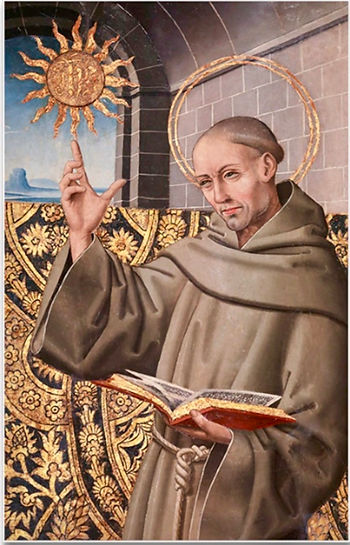
On 20th May, the Church celebrates the feast of the Italian Franciscan St Bernard of Siena (1380-1444) who was renowned as a gifted preacher of God’s Word. Like the first preachers in Apostolic times, Bernard was passionate when he preached the Gospel and was not deterred by any negative consequences of doing so. He provoked strong reactions as he went around Italy preaching repentance to thousands. His national apostolate of preaching earned him the name "the Apostle of Italy" for his efforts to revive the country's Catholicism during the fifteenth century – a ministry that continued for almost twenty-five years until his death in 1444.
As a preacher, Bernard was faithful to the Gospel by affirming the faithful as God’s beloved and yet he did not mince his words when it came to reality of sin and our need to repent. He once famously said:
“God has two arms: an arm of love and an arm of fear. With both arms he embraces the Sinner who desires to return to him. If you want to be loved by him, love him and he will prosper you; and if you fear him, he will protect you from every danger”.
Before he became a Franciscan, Bernard extended this same arm of love to people in a hospital where took charge to care for people after the outbreak of the plague. Bernard was inspired by the Dominican St Vincent Ferrer, who urged fellow preachers to “speak out of the depths of love and fatherly care, like a father suffering for his sinful children… you must always show the deepest love, so that the sinner always feels that your words come out of pure love”. Similarly for Bernard, even when preaching repentance, it is done in response to love and always in Jesus’ name. In this sense, God’s two arms of love and fear work in unison as He tries to gather all his children into his saving embrace:
"The name of Jesus is the light of preachers because it illuminates with splendour the proclamation and hearing of his word…However, in preaching it must not be proclaimed with a vile heart or a profaned mouth, but it must be guarded and spread by a pure and fervent heart."
Perhaps Bernard’s creativity and freshness as a preacher is one of his most appealing gifts. He was an elegant and captivating speaker, and his use of popular imagery and creative language drew large crowds to hear his reflections. His reputation spread to Rome where Pope Martin V invited him to preach, which he did for eighty days.
So how can St Bernard inspire what the late Pope Francis called a renewed “confidence in preaching, based on the conviction that it is God who seeks to reach out to others through the preacher, and that he displays his power through human words” (The Joy of the Gospel, 136)?
First, that we always preach in Jesus’ name. It is his Word and not ours. Second, that our words come from a pure heart that loves those we preach to. Third, that the love of God and fear of God are one and the same. To love God is to fear losing his friendship as the greatest tragedy of all. Finally, not to back away from preaching our need for repentance and conversion, keeping before us the suffering and cross of the Lord Jesus who died for us and rose to save us.
Amen 🙏🏼